
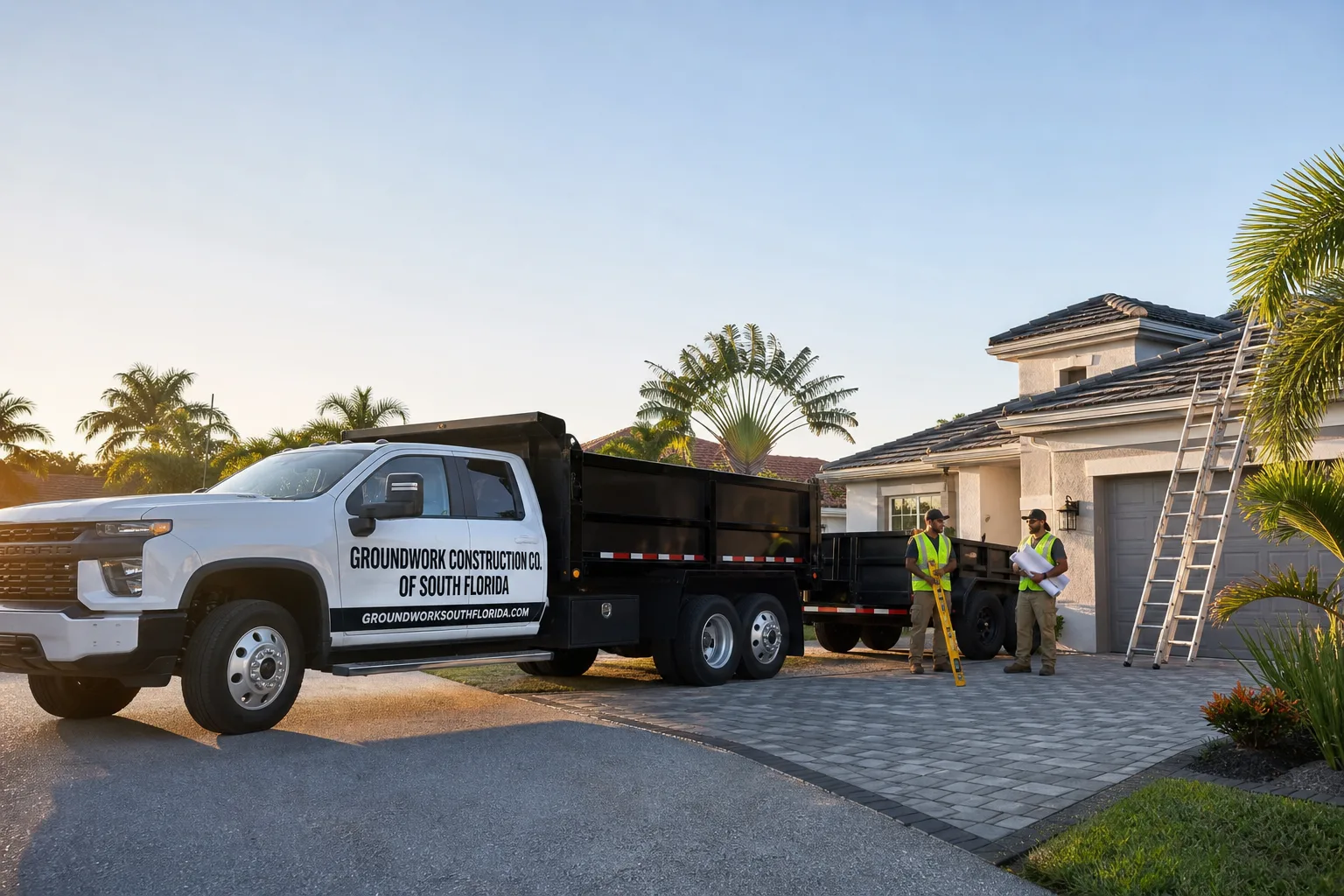
Patios, Walkways & Pool Decks in Country Club, FL - What’s Involved and What It Costs
Patios, walkways, and pool decks in Country Club typically run $3,500-$11,000 for paver patio installation, with pool deck resurfacing and walkway projects landing in similar ranges depending on size and existing conditions. Most jobs take 3-7 business days from demo to final compaction, though HOA approval and Miami-Dade permitting can add 2-4 weeks upfront. Call (844) 665-0162 to schedule a free on-site estimate - we’ll measure, check drainage, and give you a written quote with line-item pricing.
How We Build Patios, Walkways & Pool Decks - Start to Finish
We’ve learned that homeowners in Country Club want to know exactly what happens on their property and when. Here’s the sequence we follow on every hardscape job, with the decisions you’ll need to make at each stage.
Stage 1: Site measure and drainage assessment (Day 1, 2-3 hours)
We walk the space with you, check slope, and identify where water currently pools. In Country Club, this step matters more than most places - the porous Miami Limestone base and high water table during wet season mean poor drainage planning destroys a patio in two years. We bring a laser level, mark utility lines, and photograph the area for our permit drawings. You’ll decide: exact footprint, whether we’re tying into existing walkways, and if you want any elevation changes like a raised planter or step-down to the yard.
Stage 2: HOA submission and permit pull (1-3 weeks, parallel to material selection)
Most Country Club subdivisions require architectural review before Miami-Dade sees the application. We prepare elevation drawings, material samples, and a site plan. While that moves through committee, you select your pavers, border pattern, and joint sand type. We keep 3-4 paver lines on hand from Belgard, Unilock, Tremron, and Techo-Bloc so you can compare texture and color in actual South Florida sunlight, not a showroom.
Stage 3: Demolition and base prep (Days 2-3)
We remove existing concrete, old pavers, or degraded pool deck surfaces. Then we excavate to 6-8 inches below finished grade, depending on traffic load - pool decks get 6 inches, drive-adjacent walkways get 8. We install geotextile fabric, then build the base in two lifts of crushed limestone, compacting each layer with a plate compactor. In Country Club’s wet season, we may need to pump standing water or delay this stage if the water table is within 18 inches of grade.
Stage 4: Bedding, laying, and cutting (Days 3-5)
A 1-inch screeded sand bed goes down, then we lay pavers to pattern. Pool decks get special attention: we pitch everything away from the pool coping at 1/4 inch per foot, use bullnose edge pieces where feet will hit, and cut carefully around existing plumbing returns or skimmers. You’ll do a walk-through before we sand the joints - this is your moment to catch anything that looks off.
Stage 5: Joint stabilization and final compaction (Day 5-6)
We sweep polymeric sand into joints, vibrate the surface to settle it, then mist-activate the binding agent. For pool decks, we use a specialized joint sand that resists washout from chlorine splash and pressure washing. Final compaction, edge restraint installation, and cleanup. You’re back on the surface in 24 hours, though we ask you to wait 72 hours before heavy furniture or entertaining.
The Material Options You’ll Actually Choose Between
- Concrete pavers (standard 60mm): The workhorse choice. Runs $8-$14 per square foot installed. Good compressive strength for walkways and patios, adequate for light pool-deck use. Color fades gradually over 8-10 years. Best for homeowners who want a clean look without premium cost.
- Thick pavers (80mm+): $10-$16 per square foot. Heavier edge, better for drive-adjacent walkways or areas where a vehicle might occasionally roll. We often spec these for Country Club homes where the walkway connects directly to a Driveway & Pavers in Country Club project.
- Porcelain pavers: $14-$22 per square foot. Non-porous, so they resist mold and pool-chemical staining better than concrete. Thinner profile (20mm) requires a different installation method - mortar-set over concrete slab rather than sand-set. Best for pool decks where you want a modern, large-format tile look.
- Travertine or natural stone: $18-$28 per square foot. Stays cooler underfoot than concrete in direct sun - a real factor for pool decks in Country Club’s climate. Requires sealing every 2-3 years and will develop some surface variation. Choose this if you want the material to age visibly and gracefully.
- Paver pattern and border: Running bond is standard and efficient. Herringbone or basketweave adds 10-15% in labor. A contrasting soldier course border frames the space and hides minor edge settlement - we recommend it on any patio over 200 square feet.
- Joint sand type: Standard polymeric sand resists ants and washout. For pool decks, we upgrade to a formula with higher resin content that handles chlorine exposure. The cost difference is roughly $0.50 per square foot - negligible against the hassle of re-sanding in two years.
What Patios, Walkways & Pool Decks Costs in Country Club, FL
| Project Type | Typical Range | Notes |
|---|---|---|
| Paver patio installation | $3,500-$11,000 | Based on 250-800 sq ft |
| Walkway (front or side) | $2,500-$7,500 | Linear footage and curve complexity drive this |
| Pool deck resurfacing with pavers | $5,500-$14,000 | Includes coping replacement if needed |
| Raised patio with retaining wall | $8,500-$18,000 | Wall engineering adds permit complexity |
Five factors push your job to the high or low end of these ranges:
1. Existing surface condition. A cracked concrete slab that needs full removal and haul-away adds $1,000-$2,500 versus paving over stable, well-drained ground.
2. Size and shape complexity. Rectangles are efficient. Curves, radius cuts around pools, and multiple level changes add labor hours fast.
3. Drainage work required. In Country Club, we often need to install French drains, channel drains, or regrade swales to move water away from structures. This can add $800-$3,000 but prevents catastrophic failure.
4. Material grade and origin. Imported travertine versus domestic concrete paver is the biggest single material jump. We stock mid-grade options from our four paver partners to keep lead times reasonable.
5. Permit and HOA scope. Miami-Dade permits for hardscaping start around $350, but if your project touches a structure - say, a covered patio or pergola foundation - HVHZ compliance triggers engineering review and higher fees. HOA architectural review is typically $100-$300 but can require revision cycles.
A written estimate from Groundwork includes: all labor, materials, equipment, permits we pull, and disposal. It does not include: your HOA application fee, irrigation repair if we hit lines, or tree removal if roots impede the base.
What Country Club Homes Specifically Do to This Job
Country Club isn’t generic suburban Florida, and your patio or pool deck project will run into conditions that a Fort Lauderdale or Palm Beach County job wouldn’t face.
The housing stock here is overwhelmingly CBS tract homes from the 1985-2005 build era, developed as planned subdivisions with active HOAs. That means two gatekeepers: your architectural review committee and Miami-Dade Building. We’ve seen homeowners in Country Club assume a simple backyard paver patio is “just landscaping,” only to learn their HOA requires matching roofline colors, setback verification, and a 30-day comment period. We build that timeline into every proposal.
The bigger factor is what’s underneath. Country Club sits on exposed Miami Limestone with a water table that rides high - 18 to 24 inches below grade during the wet season. Any excavation for footers, drainage, or base prep hits water. We’ve had jobs in May where we pumped for two hours before we could set the first lift of base rock. That doesn’t happen in January. If your pool deck is sagging or your patio pavers are settling, the cause is almost always water migration through that porous stone, not bad installation. We address it with French drains tied to existing swales or, in worst cases, a sump pit.
Then there’s the HVHZ reality. While a standalone paver patio typically doesn’t trigger wind-load compliance, anything attached to the house - a covered patio, pergola, or outdoor kitchen foundation - does. And because much of Country Club’s housing predates Hurricane Andrew, we’ve seen simple projects expand when inspectors discover the existing slab wasn’t poured to current standards. We flag this possibility in our initial walk-through so you’re not surprised.
Homeowners here often pair exterior hardscaping with interior updates. If you’re expanding your living space outward, you might also be looking at Full Kitchen Remodeling in Country Club to connect indoor and outdoor entertaining areas, or ADU Site Prep & Utilities in Country Club if you’re adding a guest cottage with its own patio footprint. Our Country Club crew coordinates across trades so you’re not managing multiple contractors.
Nearby, we’ve done similar work in Palm Springs North, Miami Lakes, and Hialeah - but Country Club’s specific combination of high water table, HOA density, and HVHZ proximity makes it its own planning challenge.
Serving Country Club, FL - Our Local Coverage Area
We’re based in the Country Club area and know this community well. Use the map below to see our service coverage - if you’re nearby, we can almost certainly help.
Frequently Asked - Patios, Walkways & Pool Decks in Country Club
Active construction is 3-7 business days once we start demo. Total elapsed time from contract to completion is usually 4-8 weeks in Country Club because of HOA architectural review and Miami-Dade permit processing. We can’t speed up the county, but we can parallel-track material orders so nothing waits on delivery. Call (844) 665-0162 and we’ll check current permit turnaround times.
Yes, for any hard surface over 120 square feet or any work within 10 feet of a structure. Miami-Dade requires a building permit, and most Country Club HOAs add architectural review on top. We handle both submissions as part of our project management. The permit verifies drainage compliance, which protects you from future code enforcement or resale issues.
Sometimes, but we rarely recommend it in Country Club. The existing slab usually has cracks, poor pitch, or insufficient expansion joints - all of which telegraph through pavers within two years. We prefer full removal so we can correct drainage and build a proper flexible base. The extra $1,500-$2,500 in demo cost typically saves you from a $6,000+ redo.
A 200-square-foot concrete paver patio in a simple running bond pattern, installed on well-draining ground with no existing demo, starts around $3,500. That’s our honest floor in this market. Anything below that either skips base prep or uses substandard materials. We don’t build those jobs. For exact pricing on your space, we need to see drainage, access, and measure - estimates are free.
We warranty our workmanship - base construction, pitch, and joint stabilization - for two years. Material defects fall to the manufacturer; Belgard, Unilock, Tremron, and Techo-Bloc each carry their own product warranties against cracking and color degradation. The real protection is in the base we build and the drainage we plan. That’s why we document every lift with photos you can reference if issues arise.
Get a Free On-Site Estimate for Your Country Club Project
We’ll walk your property, check drainage and existing conditions, and give you a written estimate with line-item pricing for patios, walkways, or pool decks. No deposit to schedule. Call (844) 665-0162 or reach out through our site. Raymond Estevez and our Driveway & Pavers team serve Country Club and surrounding Miami-Dade communities.
Written by Raymond Estevez, Owner at Groundwork Construction Co., serving Country Club and South Florida homeowners.